

Talc
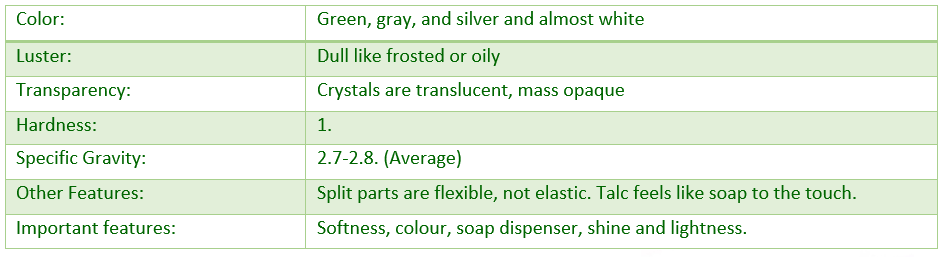
Talc is an aqueous magnesium silicate, and its theoretical formula is 3 MgO 4SIO2 H2O. It contains 63.5% SiO2, 31.7% MgO and 4.8% H2O in its ideal composition. It is white, greenish-transparent, slippery, massive, and soft. Its hardness varies between 1-1.5 according to the MOHS scale. Its density is between 2.6-2.8 gr/cm3. Talc is fire resistant. It hardens and solidifies when heated at high temperatures. It does not degrade with acids.
Usage:
Paint Industry:
Talc, which has fiber, is used in the production of paint and similar products due to its oil absorption feature. Talc fiber allows the paint layers to be clamped to each other and to the surface. It prevents heavy paint materials from collapsing and ensures that the paint is more homogeneous. Specs: Extremely white and of high grade (98.5%) with 325 mesh size.
Ceramic Industry:
Since talc has limited expansion property with heat, it has enabled it to be used in bathroom and kitchen ceramics and on the plates of electric stoves. Physical and chemical structure, grain size, color manganese and iron composition are important factors to consider.
Talc Roofing:
Poor quality talc is used for this purpose. Whiteness and purity are not sought in raw materials. Desired properties are grain size and distribution, and oil absorption. Talc provides a high level of protection against fire and weather conditions as it stabilizes the molten asphalt in roof construction. Talc also prevents gravel or roof paths from sticking together during construction and installation.
Cable | Casting | Asphalt Industry:
Talc is an active substance in cable construction. It prevents permeability. It is used as a powder between the cable, and in the outer coating with the formula. Talc is used as crucible material. Being rat-proof prevents permeability between mold and casting. It is used to cut the contact of the molten metal with the air. Talc provides hardness and rat resistance. It also does not break and prevents cracking.
Tire | Rubber Industry:
Talc is used as a filler in the manufacture of many synthetic rubbers, plastics, and rubbers. It gives the material a firm texture. Talc is used as a filling material. Average grain size of 2µm provides resistance to electricity, flexibility ..
Paper Industry:
Talc can be used comfortably in the paper industry due to its softness, grain size, ink absorption and water-soluble properties. However, the CaCO3 ratio of the talc to be used should not be more than 2% – 5% and should not contain other minerals.
Food | Pest control and Fertilizer Industry:
Talc is used as a filler in gum, yeast, and animal feed. It is used as an anti-adhesive in candy and chocolate. Talc is used to make pesticides. It gives the drug the properties of toxic effect, desired density, and low abrasiveness.
Cosmetic and Pharmaceutical Industries:
Talc is used in cosmetic products due to its chemical purity and lubricity. The properties sought in talc used in the pharmaceutical industry are the low content of fibrous and hard minerals, and the low amount of arsenic and iron.
Description
Be the first to review “Talc”
You must be logged in to post a review.
Reviews
There are no reviews yet.